
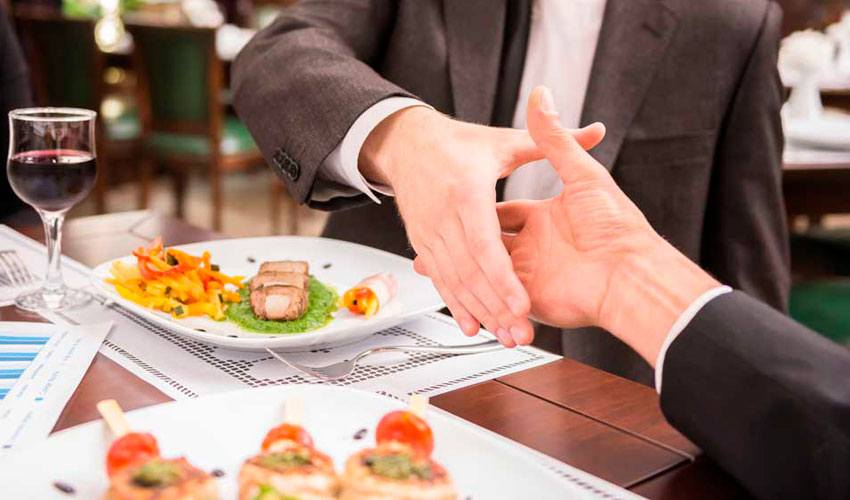
The high court estimates that, contrary to the Treasury's approach, it will no longer be necessary to justify these expenses to prove a subsequent income of the client
Self-employed workers may deduct the work meals they carry out with their clients, regardless of whether or not they agree to a collaboration contract. This was determined by the Supreme Court in a ruling issued last March. In it, it breaks with the doctrine on which the Treasury had been considering these expenses not deductible, understanding that they were not directly related to the activity carried out by the self-employed worker.
The paradigm shift in the assimilation of these expenses is housed in the consideration that the Supreme Court makes of them, and which it now places under the umbrella that its objective is to “achieve a better business result.” “Therefore, those expenses that, being donations or liberalities, are deductible” – this consideration was what prevented them from being deductible – “are colloquially known as services to clients or to the staff themselves.” Therefore, the need required by the Treasury to present proof of income to recognize the work nature of that meeting ends.
From now on, to prove the meeting, it will be enough to submit a text or WhatsApp message, an email ―in which the client is informed of the willingness to arrange a meeting in the form of a meal―, a phone call, or with demonstrate that the other person belongs to the usual client portfolio.
Future result
In the ruling, the Supreme Court understands that although work meals, gifts to clients or promotional expenses do not seek “a direct and immediate achievement of the best results,” due to their very nature and characteristics “they pursue an indirect and future result.” ”. Reason why they can be correlated with income. “Customer and supplier service fundamentally seeks to build customer loyalty for the future,” he adds.
Sentence, HERE.
 English
  Spanish