
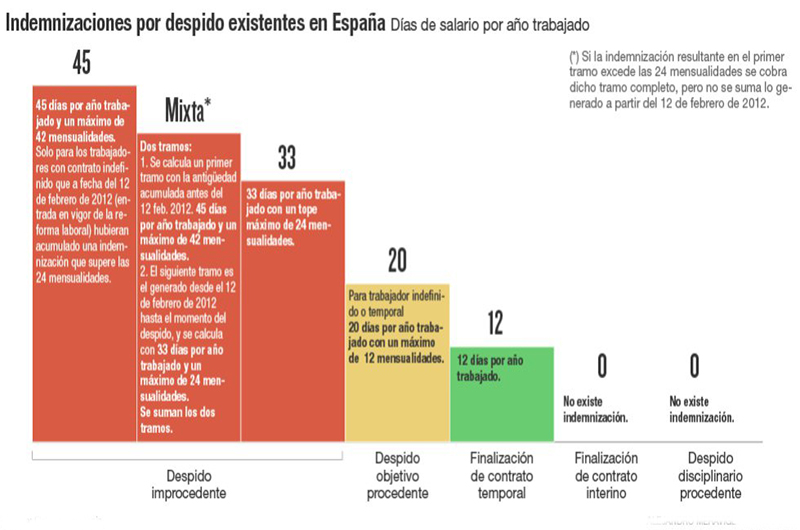
In the labour market there are five different amounts of severance pay and two situations in which nothing is paid
The discrimination that temporary workers have suffered until now compared to permanent workers at the time of dismissal has been recognized as not in accordance with European regulations by the European Court of Justice, according to a ruling that was made known last week in which the Spanish courts and, therefore, its legislators, are asked to equate the severance pay of temporary employees – interim in the specific case of the aforementioned court ruling – and those with a permanent contract.
Once the ruling was announced, reactions were not long in coming, and unions are already preparing a series of lawsuits to demand higher compensation for temporary workers whose contracts are ending or have ended in the last year; at the same time, most labour experts believe that the next government should adapt the legislation to what Brussels has said.
However, the interpretation of the Government, which must enforce the ruling, is very different, as it adheres to the literal meaning of the ruling and considers that only the compensations of temporary workers should be equal. In addition, it assures that the ruling "makes it clear" that there can and do exist different contractual modalities in EU labour regulations. This is the different case law of the current severance pay in Spanish law:
45 days compensation
The historic severance pay of 45 days per year worked with a cap of the amount equivalent to 42 monthly salaries ceased to apply generally for all unfair dismissals (of permanent and temporary workers) on February 12, 2012, when the labor reform came into force. This reform reduced this general compensation to 33 days per year worked with a cap of 24 monthly payments.
However, the new formula for calculating compensation means that only workers with permanent contracts who, as of February 12, 2012 (when the labor reform came into effect), had accumulated compensation exceeding the equivalent of 24 monthly payments, will retain exclusive compensation of 45 days.
Mixed 45/33 days
This compensation was created in the 2012 labour reform and is for workers who were dismissed after the new law came into force, but had seniority before that date. Thus, it is the most common compensation at present, since 71% of permanent workers have a seniority in their job of more than six years (eight million employees). To these we should add the 13% of temporary workers who have also been in their job for more than six years and who, in the event of being unfairly dismissed before the end of their contract, would also receive said compensation.
Thus, since February 12, 2012, a double calculation of compensation is made. A first section is calculated with the seniority accumulated before that date. This section is calculated with 45 days per year worked and a maximum of 42 monthly payments.
The second section corresponds to the period generated from February 12, 2012 until the time of dismissal, and is calculated with 33 days per year worked and a maximum of 24 monthly payments.
Once this double calculation is done, the resulting compensations are added together. But there is one exception: workers who have obtained in the first tranche an amount of compensation equivalent to more than 24 monthly payments. In that case, they would only receive the amount generated in the first tranche.
33 Days Compensation
The general compensation for all unfair dismissals (permanent and temporary) since February 12, 2012 is 33 days per year worked with a cap of the amount equivalent to 24 monthly salaries.
20 days compensation
Workers (permanent and temporary) who are subject to an objective individual or collective dismissal (for economic, technical, organizational or production reasons) and who are found to be appropriate, have compensation of 20 days per year worked with a maximum of 12 monthly payments.
Minimum compensation of 12 days
Temporary contract workers receive compensation of 12 days per year worked upon termination of their contract on the scheduled date.
Without compensation
Temporary workers (around 300,000 in public administrations and 200,000 more in the private sector) do not have severance pay at the end of their contract. However, if they were unfairly dismissed before the end of their contract, they would also have the same severance pay as before.
Nor do workers who have been properly dismissed for disciplinary reasons have it.
You can ask us any questions regarding the compensation that your employees may be entitled to in the event of a hypothetical dismissal. Contact us.
 English
  Spanish