
A new line of direct aid, endowed with 7,000 million euros, will facilitate the payment of fixed expenses and debts to the sectors most affected by the pandemic. Another 3,000 million will be dedicated to restructuring the financial debt that has State guarantee, and a fund of 1,000 million will be used for the recapitalization of companies.
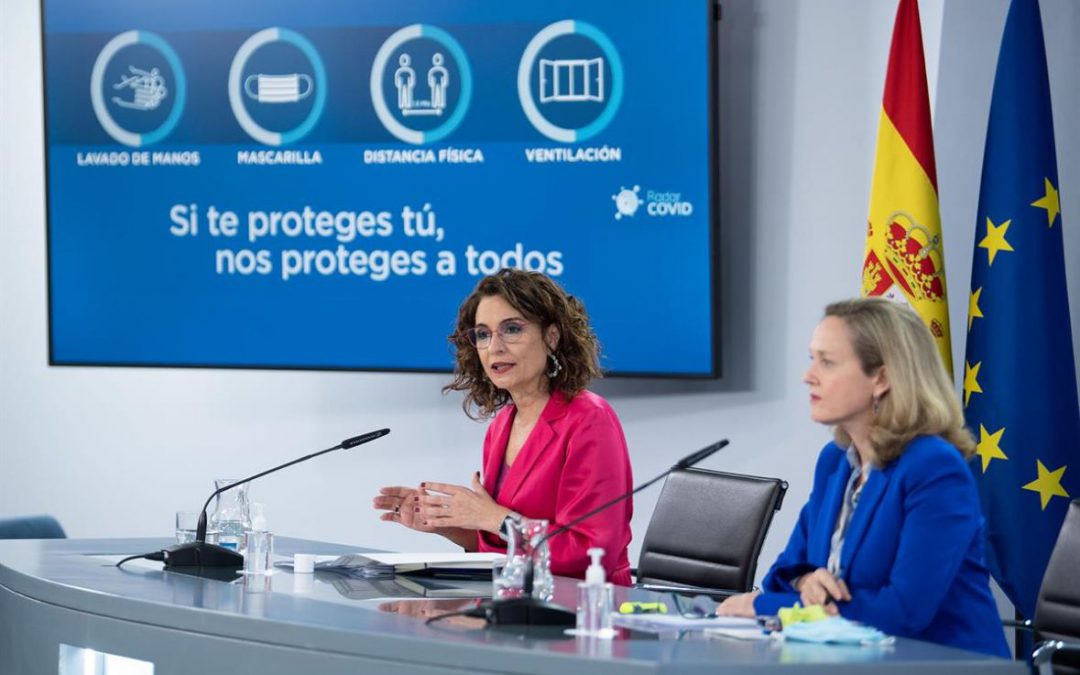
The Council of Ministers has approved a package of extraordinary measures to support business solvency in response to the pandemic. The Minister of Finance and Government spokesperson, María Jesús Montero, has indicated that the Executive continues the work it has been carrying out since the declaration of the first state of alarm, a year ago, to minimize the impact of COVID-19 on the productive fabric. and employment.
Anticipate solvency problems
The third vice president and minister of Economic Affairs and Digital Transformation, Nadia Calviño, has explained that the measures seek to anticipate possible solvency problems due to activity restrictions in the sectors and territories most affected by the pandemic. "We try to alleviate the drop in income and over-indebtedness that could put the survival of perfectly viable companies at risk and, thereby, hinder the recovery," he assured.
The vice president has highlighted that the daily activity indicators point to a slowdown in the first quarter of 2021, in line with the rest of the European countries during the third wave of the pandemic, but the forecasts of all organizations point to an improvement as the year progresses and in 2022. This trend is also confirmed by the most recent labor market data, including the reduction in the number of workers subject to temporary employment regulation files (ERTE).
Nadia Calviño has indicated that, together with the ERTE, the guarantee lines of the Official Credit Institute (ICO) channeled through the financial sector have been key in maintaining the productive fabric - more than 121,000 million euros have been mobilized -, the extraordinary benefit for the self-employed, banking, tax and Social Security moratoriums and other exemptions.
New funds and extension of moratoriums
The minister has stated that there are still difficult weeks ahead and it is necessary to anticipate the risk of a significant deterioration in companies' balance sheets and an increase in debt. The Royal Decree-Law approved today seeks to continue protecting the most affected sectors that are fundamentally viable, while reaching a substantial percentage of the vaccinated population. "By acting at the right time, as we have done from the beginning, we avoid a higher cost in the future," he maintained.
The rule is divided into three funds: a line of 7,000 million euros for direct aid to companies and the self-employed for the payment of fixed expenses and debts with suppliers and other creditors; a line of 3,000 million so that the ICO can accompany the financial debt restructuring processes, and a fund of 1,000 million for the recapitalization of the affected companies.
In addition, bankruptcy moratoriums and streamlining measures in the field of justice are extended until the end of the year to provide a period to restore asset balances or address restructuring processes, among other actions.
This line will allow the autonomous communities to grant direct aid to the companies and sectors most affected by the pandemic. It consists of two compartments: one with 2,000 million euros specifically for companies in the Canary Islands and the Balearic Islands, the regions where the tourism sector has a greater weight; and another of 5,000 million euros for the rest of the communities, which will be distributed based on indicators of income, unemployment and youth unemployment.
The aid is non-refundable and finalist in nature and must be used to pay debts incurred since March 2020, both invoices with suppliers and fixed expenses such as bank or financial debts, energy supplies, etc. Companies and self-employed workers whose income has fallen by at least thirty percent compared to 2019 will be able to access them, within a set of almost one hundred sectors and activities, the most affected by the restrictions.
The aid may compensate for up to forty percent of the additional drop in income for micro-SMEs and the self-employed and up to twenty percent for other companies. A fixed amount of 3,000 euros is established for the self-employed who pay taxes by modules and a range between 4,000 and 200,000 euros per company for the rest.
Nadia Calviño has highlighted that these 7,000 million euros are added to the 24,000 already transferred by the State to the communities to provide a health, economic and social response to the pandemic.
Line for the Restructuring of financial debt
In the restructuring processes of viable companies with temporary problems that are agreed upon with financial entities, three levels of action may be applied to loans that have public guarantee.
A first level involves the extension of the maturity period of the loans, in addition to the extension approved last November. At a second level, these loans could be converted into participatory loans, maintaining the coverage of the public guarantee.
At the third level, exceptional and last resort, direct transfers would be allowed to the self-employed and SMEs to reduce the principal of the guaranteed financing contracted during the pandemic.
In order to articulate these measures - Calviño has indicated - a Code of Good Practices will be approved so that the financial sector and other organizations can get involved in supporting these companies.
Business Recapitalization Fund
This fund will be managed by the Spanish Development Financing Company (Cofides), dependent on the Ministry of Industry, Commerce and Tourism, and complements the SEPI fund for the recapitalization of larger strategic companies.
Its use will entail the participation of the State in the future profits of the companies, as well as an exit strategy, since the temporary nature of the fund is set at eight years, as detailed by the minister.
Access requirements
To access all this new aid, companies must maintain their activity until June 30, 2022 and will not be able to distribute dividends or increase the remuneration of senior management for two years, in addition to meeting the rest of the usual requirements (not having their tax domicile in a tax haven, not being bankrupt or having ceased activity at the time of the application, being up to date with the payment of tax and Social Security obligations...).
María Jesús Montero has specified that the Royal Decree Law provides that within a period of one month and ten days, the Government will have formalized the order for the distribution of the fund to the autonomous communities after the signing of the corresponding agreements and with the objective that as much as sooner they are available to help the productive fabric.
Nadia Calviño has stressed that, ultimately, the Royal Decree-Law completes an "unprecedented battery" of instruments to support companies with solvency problems, always with the aim of maintaining activity and employment. That is the fundamental goal for the coming months, which requires focusing efforts on four priorities: controlling the pandemic, accelerating the vaccination process, ensuring financial stability, avoiding a structural impact on the productive fabric and deploying the Recovery Plan. Transformation and Resilience in an agile and effective way.
Royal Decree Presentation: LINK
 English
  Spanish