
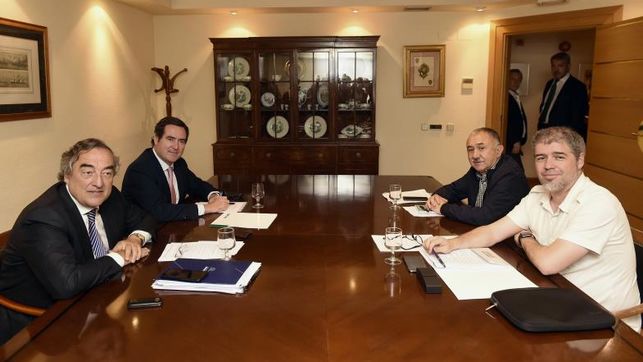
The leaders of UGT, CCOO, CEOE and Cepyme have signed this Thursday the IV Agreement for Employment and Collective Negotiation (AENC), already supported internally by the parties involved
The agreement includes annual salary increases of "around 2%" fixed plus a variable 1% and a minimum salary of 1,000 euros by agreement to be reached by 2020
Although it does not contain any obligations, it will be the roadmap for social agents throughout Spain when they negotiate sectoral and company agreements over the next three years.
The agreement for a salary increase of up to 3% per year for the next three years is now a fact. The general secretaries of CCOO and UGT, Unai Sordo and Pepe Álvarez, and the presidents of CEOE and Cepyme, Juan Rosell and Antonio Garamendi, have finally signed this Thursday the IV Agreement for Employment and Collective Negotiation (AENC), after the pre-agreement reached last week was supported internally by the parties involved. The agreement includes as a novel measure, highly praised by the new Government, a minimum salary by agreement of 1,000 euros per month in 14 payments, to be reached by 2020.
The representatives of the employers' association and the unions have sealed this latest AENC early in the morning at the headquarters of the Economic and Social Council (CES) in Madrid. All the protagonists have stressed the importance of having reached this agreement, after failing to sign it last year. "It was a mistake," said Juan Rosell.
The current Minister of Labour, Migration and Social Security, Magdalena Valerio, and her predecessor in office, Fátima Báñez, who worked with the social partners during her mandate to reach this agreement, attended the event. In fact, Báñez also posed in the photographs of the event with Valerio and the leaders of the businessmen and trade unions.
Although it is an agreement that does not contain obligations, its content will be the roadmap that will guide collective bargaining throughout Spain in the preparation of sectoral and company collective agreements over the next three years. Pepe Álvarez has maintained that from now on "a new path" of dialogue begins to reach consensus, also at a political level with the Government and the rest of the political forces "to lead workers to real recovery."
Annual salary increase up to 3%
Regarding the salary increase, possibly the element that attracts the most attention from the AENC (although not the only one it addresses), the parties have agreed to an increase in two parts: of “around 2%” fixed plus a variable 1%, depending on productivity, company results and unjustified absenteeism. Every year until 2020. The president of the CEOE, Juan Rosell, has stated that the increase in salaries is important “from the decency and intelligence from a business point of view”, due to its contribution to boosting internal demand.
Unai Sordo stressed that the agreement is "clearly aimed at the recovery of wages" after the devaluation they have suffered in recent years. In 2016, wages fell by 1.61 TP3T, according to the Labour Price Index (IPT), and have accumulated a fall of 8.61 TP3T between 2008 and that year. The general secretary of CCOO had a special memory for Mercedes González, confederal secretary of Trade Union Action of CCOO who passed away on June 8 and who worked on the preparation of the AENC.
On the other hand, the unions have managed to introduce their star bet: that the lowest salaries would rise more with a minimum wage by agreement. This has been set at 1,000 euros per month (14,000 per year) to be reached during the validity of the agreement, until 2020. According to the calculations of Comisiones Obreras, it could mean increases of between 12 and 20% in the majority of agreements (even 38% in the case of services for the care of people with disabilities, with very low salaries). The secretary of UGT has praised that this point affects some groups that find more difficulties in the labour market, such as young people and women.
The agreement also addresses 'ultra-activity' (automatic extension of an agreement in the absence of another to replace it), so that it does not lapse during the negotiation of the next agreement. Currently, this renewal is marked by the one-year time limit established by the 2012 labour reform.
Changes in the labour reform on the horizon
The unions and employers' associations include in their agreement a series of recommendations to be addressed with the Government on labour matters. These include amending Article 42 of the Workers' Statute, which regulates the subcontracting of works and services; "developing comprehensive measures" to promote labour and salary equality between men and women (among which are equal and non-transferable maternity and paternity leave); promoting a legal reform of Vocational Training for Employment, and creating an Observatory on absenteeism at work that will issue a report on the subject within 6 months, among other issues.
The Government of Pedro Sánchez has expressed its intention to change several aspects of the PP's 2012 labour reform, but has reiterated that it will do so after reaching consensus with social stakeholders and after obtaining more parliamentary support. The unions and employers have encouraged the other political forces to get involved in achieving consensus. "This will work if we all go in the same direction," stressed the president of Cepyme, Antonio Garamendi.
Both Garamendi and Rosell have emphasised the need to review training in the workplace to address technological changes in the labour market. "Many jobs will disappear, others will be created, but what we know is that 80% of the jobs that exist will be transformed," stressed the Cepyme leader.
The President of the Government, Pedro Sánchez, will meet again with the social partners (CCOO, UGT, CEOE and Cepyme) next week, probably on July 10, according to Europa Press.
 English
  Spanish