

Incibe warns of malware that arrives by email impersonating the Ministry.
An alleged notification of an extrajudicial process from the Ministry of Labor. This is the new scam against self-employed workers. These professionals supposedly receive an email with the subject 'Fdw: Urgent – Extrajudicial Work Process No. (random numbers)' which turns out to be a Trojan.
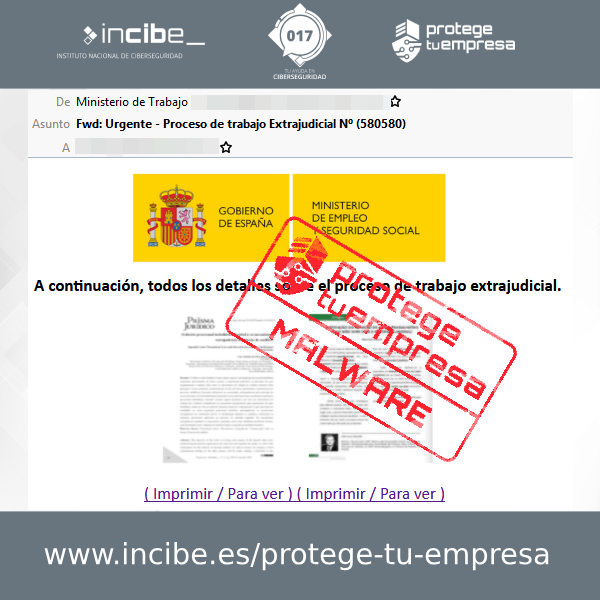 The National Institute of Cybersecurity (Incibe) has warned about an alleged impersonation campaign targeting self-employed workers and spread via email. According to the warning, cybercriminals use this technique to confuse recipients into thinking that they are being contacted by the Ministry of Labour and Social Economy.
The body of the message pretends to be writing to the self-employed person from the Ministry itself and includes a PDF file. This document is malicious, in fact, they warn that when you go to the preview, a browser page opens and a compressed file (.zip) is downloaded from it, which contains the Trojan.
According to Incibe, this malware is designed to “prepare the computer to be the victim of a subsequent attack.” On the other hand, they point out that other malware could also be installed that allows the theft of data or important information, or a ransomware infection to the computer or device itself.
Train employees
To protect your information and your computer, it is recommended not to open emails from unknown sender. It is also recommended to keep backup copies and save documents on other devices in order not to lose information, data or documents stored on the infected device.
Install antivirus and make backups
Incibe also adds that it is important to avoid this type of malicious attack by properly training employees and checking devices, programs and the strength of their passwords.
To mitigate these attacks, it is also advisable to have antivirus programs installed to warn when there is danger, and to keep the operating system updated.
They add that this type of email is intended to confuse the recipient, so it is advisable to delete them as soon as they arrive in the inbox.
 English
  Spanish