
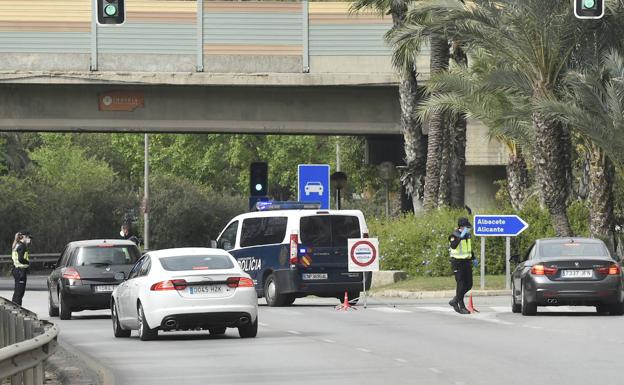
The regional president, Fernando López Miras, announced during his appearance on Sunday afternoon that the measures to be adopted by the Government Council would go beyond the curfew established at the national level by the new Royal Decree of the state of alarm approved by the national Executive.
The restrictions finally approved in the Autonomous Community under the umbrella of the regional law and this exceptional state are the following:
Mobility during curfew
– A curfew is established, effective from this Sunday, which restricts the freedom of movement of people at night between 11 p.m. and 6 a.m. - maintaining what was established by the central Executive - except for the reasons justified and excepted by the norm, which are the following: Acquisition of medicines, sanitary products and other essential goods; assistance to health centers, services and establishments; assistance to veterinary care centers for urgent reasons; compliance with work, professional, business, institutional or legal obligations; return to the place of habitual residence after carrying out some of the activities provided for in this section; assistance and care for the elderly, minors, dependents, people with disabilities or especially vulnerable people; due to force majeure or a situation of need; any other activity of a similar nature, duly accredited; refueling at gas stations or service stations, when necessary to carry out the activities provided for in the previous paragraphs.
– Between 11 p.m. and 6 a.m., only those establishments that usually provide essential services at night, such as health establishments, pharmacies, veterinary care establishments or service stations, may open.
– Eating and drinking in public spaces other than hospitality and catering establishments is prohibited when it is not possible to maintain a safe distance, except for cohabitants.
– Visits to student residences by people from outside the residence are suspended. These centres must also limit the occupancy of common areas to one third of their capacity.
Capacity in premises, establishments, celebrations and other types of events
– In the event that postponing wedding celebrations and other civil and religious ceremonies is not possible, the maximum number of participants remains at 30 people both outdoors and indoors, and they must remain seated at all times.
– The maximum permitted occupancy of the interior of hospitality and catering establishments will be 30% of the capacity, except in those municipalities for which more intense measures have been expressly approved. The maximum permitted occupancy of terraces and outdoor spaces in establishments intended for hospitality, catering, gaming and betting in all municipalities of the Region will be the total authorized.
– The use of a mask will be mandatory at all times in hospitality establishments, and may only be removed when eating or drinking.
– In the case of markets or street markets that operate on public roads, the number of authorized stalls may not exceed 75%.
– Academies, training centres, public and private non-regulated teaching centres and driving schools will try to carry out their activities remotely. In those cases where this is not possible, the maximum occupancy of the facilities will be 50% of their capacity, with a maximum of thirty people in each group. Any space that is not covered by more than two side walls, walls or walls will also be considered a terrace.
– The maximum permitted occupancy of common areas in hotels, hostels, inns and other tourist accommodation will be one third of their usual capacity, and areas intended for catering may be kept open exclusively for guests staying there.
– The use of shared rooms will be limited to people who live together or have a bond.
– In libraries, archives, museums, exhibition halls, monuments and other cultural facilities, the maximum permitted occupancy will be 50% of the capacity.
– The maximum occupancy allowed in cinemas, theatres, auditoriums, tent circuses and similar activities in closed establishments and outdoor cultural activities will be 50% of their capacity.
Sports practice
– Non-professional sporting events and sports activities involving the movement of a large number of participants are suspended. Individual outdoor practice is permitted.
– Training or activity groups may not exceed fifteen athletes per instructor or coach in indoor facilities, and twenty-five in outdoor facilities, ensuring a safe interpersonal distance of 1.5 metres.
– Sports may be practiced indoors in closed premises, although the maximum occupancy of these may not exceed one third of their capacity.
– The development of activities of municipal sports schools and extracurricular sports activities is suspended.
– The practice of federated sports for minors under 18 years of age will be limited to training, and the start of competitions will be suspended. The practice of federated sports in regional competition for those over 18 years of age will also be limited to active training, although the suspension of the start of competitions has a horizon of 28 November, the date on which their resumption will be assessed in view of the evolution of the epidemiological data. During training, participants must wear a surgical mask.
– Authorized sporting competitions or events held in sports facilities may be held with spectators provided that they remain seated and maintain the appropriate interpersonal safety distance, with a maximum occupancy limit of 50% of the capacity.
– In public indoor swimming pools, whether for sports or recreational use, the maximum occupancy allowed will be one third of their usual capacity.
Residences, senior centers, disability and early care
– As a general rule, family visits to residential centres will be restricted to exceptional cases. They will be limited to outdoors and/or garden areas or indoor areas designated for this purpose.
– Admission, re-admission and transfer of residents and users are suspended except in cases of social emergency or other duly justified causes.
– Users of senior day centres will receive the service via telephone, telematics and/or face-to-face care at home or in their surroundings.
– All social centres will remain closed, and the provision of podiatry and hairdressing services currently providing these services will be suspended.
– In-person activities in day centres for people with disabilities and Personal Autonomy Promotion Services will be limited to very small groups (2-3 people), preferably for those users who, due to their social and family situation, require assistance (behavioral problems, lack of resources, difficulties in reconciling work and family life). The rest of the users will receive care online. In-person activities will be subject to a responsible declaration from the director or manager of the corresponding centre.
– Early childhood development and care centres will continue to operate in person.
 English
  Spanish