
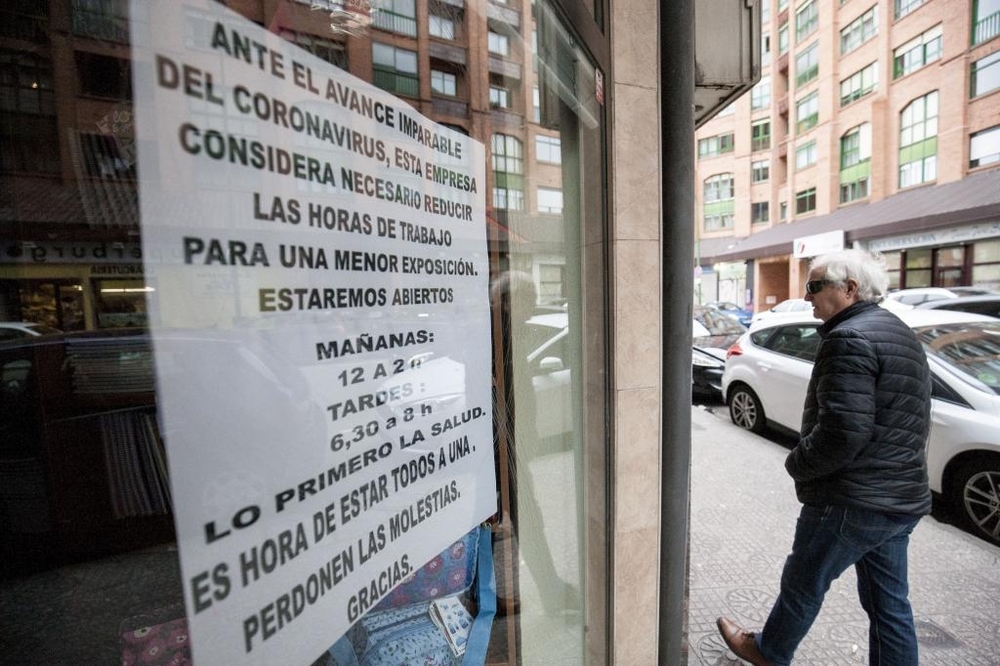
The Royal Decree contemplates, among other things, financial support measures for SMEs and the self-employed, the assimilation of those infected and isolated due to a work accident, a special line of financing for tourism and retail companies, and temporary financial support measures, such as postponements of taxes.
Yesterday, Friday, the BOE published the Royal Decree-Law 7/2020, of March 12, by which urgent measures are adopted to respond to the economic impact of COVID-19, which includes, among other things, the support measures enabled in an extraordinary manner to alleviate the economic effects of the coronavirus crisis on companies and self-employed, which in some cases is leading to temporary closure, and which in the rest has a direct impact due to the brutal drop in economic activity.
As stated in its statement of reasons, this Royal Decree-Law aims to adopt new measures to respond to the negative economic impact that is occurring in the health field, in the tourism sector, and on the people affected by the containment measures adopted by the competent authorities, as well as preventing a greater negative economic impact on SMEs and the self-employed, for whom financing support is planned.
In the DR, in coherence with what is established for workers included in the General Social Security Regime by Royal Decree-Law 6/2020, of March 10, by which certain urgent measures are adopted in the economic field and for the protection of public health, and in order to prevent the spread of the disease and maintain the social protection of citizens, it is also established for personnel included in the administrative mutualism regime that periods of isolation or contagion as a consequence of COVID -19 will be considered situation assimilated to a work accident for the purposes of the financial benefit for temporary disability of the corresponding special Social Security regime.
This royal decree-law articulates a financing line to certain companies and self-employed workers who are considered especially affected by COVID-19, such as those in the tourism sector and retail trade.
Given the exceptional situation caused by COVID-19, it may have a special impact on the employment of employees. discontinuous permanent workers who work in the tourism sector and in all sectors linked to it in all autonomous communities, in this royal decree-law, as an extraordinary measure, the application of this bonus is anticipated and extended to the months of February to June 2020 with respect to those workers who can be more affected by the exceptional situation mentioned in all the autonomous communities.
Finally, it includes temporary financial support measures. Thus, the aim is to mitigate the possible impact that the reinforced containment scenario may have on the most vulnerable sectors of the economy, that is, SMEs and self-employed.
With this purpose, to avoid possible treasury tensions that these groups may experience, a flexibility regarding postponements, granting this facility for six months payment of taxes to SMEs and the self-employed, upon request, in terms equivalent to a three-month waiting period.
Lastly, and given that the emergence of COVID-19 is affecting the value chain of broad industrial sectors, especially internationalized and is increasing the cost of production due to the higher logistical cost of importing parts and supplies, economic operators are provided with financial support measures to be able to compensate, as far as possible, the decreases in their ordinary income and provide themselves with liquidity to meet their obligations.
In this sense, it is considered essential that companies that have received financial support for industrial investment through loans from the General Secretariat of Industry and Small and Medium Enterprises can request a deferral of reimbursement.
 English
  Spanish