
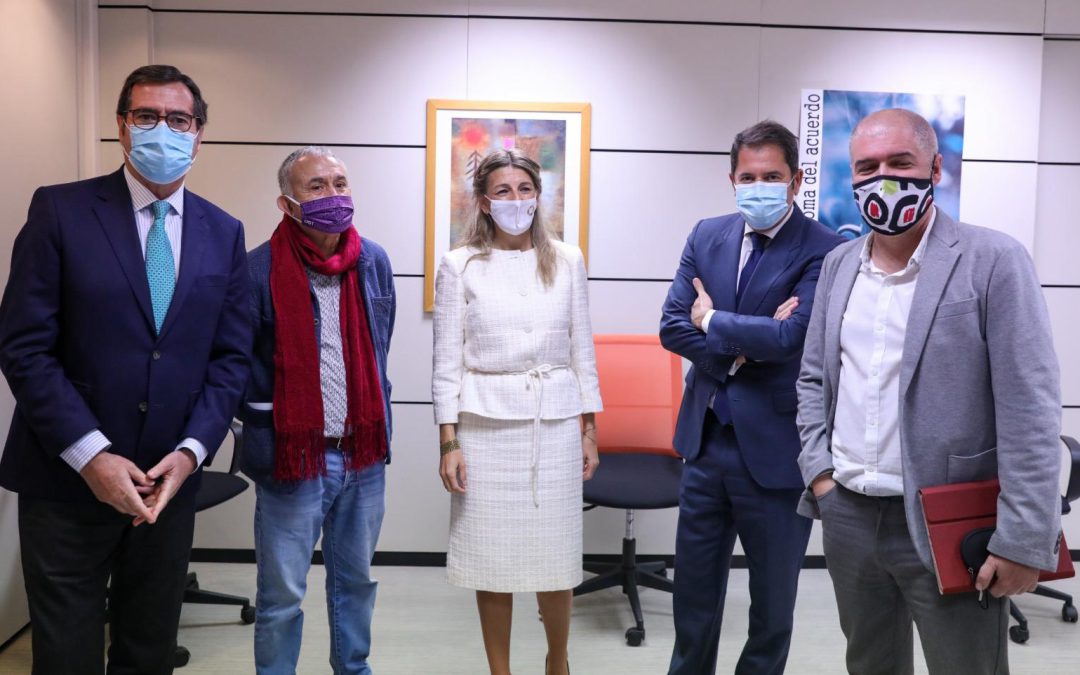
While the CEOE meets this Wednesday with its leadership to focus its position, the unions demand that the conditions under which a company can resort to temporary workers be tightened - and that, in turn, the measure be "accompanied by restrictions on dismissal" .
With just over two weeks left until the deadline that the Government has agreed to with Brussels to approve the labor reform, both unions and employers are pressing for the final text to be as close as possible to their postulates.
For their part, the unions criticize the excessive "optimism" that, in their opinion, the Government maintains regarding the possibility of reaching an agreement, which they do not see as guaranteed, while, for their part, the employers' association has already made it clear that If it doesn't satisfy their needs, they will say no.
Given these public approaches in the final stretch of the negotiations, meetings between the Government and social agents will be daily for the rest of the week to try to unblock conversations in which the thorniest issue continues to be the temporary hiring model that will be designed. . Despite these difficulties, First Vice President Nadia Calviño insisted this Tuesday that the labor reform "will be taken to the Council of Ministers before the end of the year", at the latest on December 28.
However, progress is being made on the part of the unions on matters that were blocked, such as regarding the temporary contracting model.
The positions between the Government, employers and unions have become closer since, last week, the Ministry of Labor renounced its proposal to establish limits on the number of temporary contracts that a company can make depending on its size and proposed, instead , a new model in which the time by which a company can justify that production circumstances force it to temporarily reinforce its workforce is limited to three months.
Of course, in this regard the unions have made their two red lines clear: that this new design be accompanied by a reinforcement of the "causality" of the contracts - that is, that the conditions under which a company may resort to temporary ones - and that, in turn, the measure is "accompanied by restrictions on dismissal."
These restrictions would complement another of the measures that are being negotiated: the establishment of a permanent ERTE mechanism that gives incentives to companies so that, in times of difficulties, they opt for the possibility of reducing working hours instead of laying off employees. the workers, in the style of what has happened during the pandemic. Employers and unions agree that this mechanism should be put in place, although it has not yet been possible to agree on its design after the Government had to significantly modify its first proposal, which was branded "farrageous" by the social agents.
The second of the great "chapters" that still remain to be closed in the negotiation of the labor reform is the rebalancing of collective bargaining. On this matter, Sordo, leader of CCOO, was inflexible: the unions, he said, will not support any labor reform that does not reinstate the ultraactivity of the agreements - that is, that they remain in force when they expire until a new one is negotiated - and that does not prohibits "company agreements from reducing the salaries included in sectoral agreements." "If the prevalence of the company agreement over the sectoral agreement is not modified, there will be no agreement," he assured.
The CEOE shakes off the pressure
Less explicit with its approaches is the CEOE, which in recent weeks has adopted a strategy of silence after a few months in which it came to describe the Ministry of Labor's proposals for labor reform as "Marxist." Garamendi, however, denied this Tuesday that he felt "pressured" by the Government to reach an agreement, after having withdrawn from some of the latest agreements, such as the increase in the minimum wage to 965 euros or the increase of 0.6 points in the social contributions over the next ten years to fill the pension pot.
The leader of the CEOE, however, also wanted to mark his position this Tuesday and left the employers' support for the labor reform in the air. "We are committed to being able to talk about improvements" in the text, said Garamendi, who nevertheless stated that the CEOE will only support it if "for companies it is something appropriate." The president of the employers' association also recalled that the employers are not "at all concerned" with the coalition agreement between PSOE and Unidas Podemos, which includes the main measures that both agreed to modify labor legislation.
Likewise, Garamendi defended the PP labor reform that, precisely, the Government wants to modify with the norm that it negotiates with social agents. In fact, the leader of the CEOE pointed out that, behind the current employment recovery figures, there is "a law, a regulation that has been valid for this to happen", in reference to this reform of the PP.
Source: EFE
 English
  Spanish