
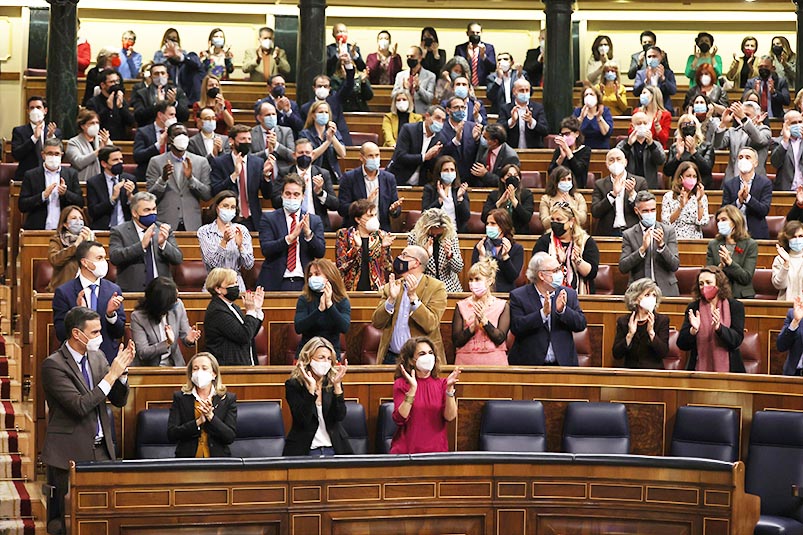
The new norm repeals important aspects of the one approved by the PP in 2012 and has the support of businessmen and unions
The first labor reform agreed upon with employers and unions was approved this Thursday in Congress. After months of negotiations between the employers, the unions and the Government, they have achieved consensus between all parties to draw up the standard that will regulate the labor market in the coming years.
The new labor law pays special attention to the fight against temporary employment, redefining the types of contracts and limiting temporary employment. The salary improvement and the recovery of the negotiation mechanisms of workers with employers are other innovative aspects that favor employees. But to make everything clearer, we are going to explain the 10 key points of this new, and long-awaited, labor reform that replaces the 2012 one, proposed by the PP.
Very specific temporary contracts and priority for the indefinite
With the new labor reform, the permanent contract will be the predominant one and only temporary contracts will be allowed for very specific reasons such as, for example, production circumstances and/or substitutions. In this way, the temporary model of work and service that allowed the worker's precariousness to be extended up to four years is eliminated.
Discontinuous fixed contract
This redefined model serves as a bridge between the indefinite contract and the void generated by the suppression of the temporary work and service model. The workers subject to this contract will not work all year round, but the new rule establishes that this group's seniority will be computed for the entire period of their employment relationship and not only during the time they have carried out their activity.
During periods of inactivity, workers - already registered on job boards - will be able to increase their training.
Training contracts
In this contractual modality we find two variants: alternation and to obtain professional practice.
The first is the model designed for those who want to combine work with studies. Only students up to 30 years old will be able to access it and for a maximum of two years. The worker's working hours will be a maximum of 65% during the first year and 85% in the second. The second is for students who already have the certification. They will be eligible for these contracts for the next three years, five if they are people with disabilities. The salary must be appropriate to the agreement and the term of the contract will be from six months to one year.
Outsourcing
A relevant change is found in subcontracting. Workers of multi-service companies that offer their activity to others, for example in cleaning or maintenance, will no longer be affected by the agreement of the subcontracted company. Workers' salaries are regulated by the agreement that the sector has.
Collective negotiation
From now on, indefinite ultraactivity returns. That is, once the agreement expires, the signed conditions will be respected until a new agreement is signed, whether negotiations between employers and unions are delayed or not.
ERTE, under review
The new text reformulates the regulation of ERTEs for economic, technical, organizational or production reasons or those derived from force majeure to incorporate some of the elements and obligations that were established in the ERTEs due to Covid. Companies that take advantage of one of these mechanisms will have, as now, exemptions from Social Security contributions that will range between 20% in cases of ERTE for economic reasons (ETOP) or sectoral modality, up to 90% in ERTE. By force majeure. Of course, they will be obliged to provide training to their workers.
RED Mechanism
The RED mechanism for Flexibility and Stabilization of Employment is created to promote ERTE to the detriment of layoffs. It will allow companies, once activated by the Council of Ministers, to request temporary measures to reduce working hours and suspend employment contracts. It will have two modalities: cyclical and sectoral.
Strong economic sanctions
To put a stop to irregular hiring, a new scale of sanctions is established, which are individualized (they will be paid by each worker and not by company, as now) and rise to 10,000 euros compared to the current 8,000 euros. Furthermore, failure to comply with the rules that regulate temporary hiring will result in the worker being considered permanent.
Entry into force of the labor reform
The labor reform was published in the BOE on December 30 and came into force the day after its publication, although not all the approved points are applied for now.
The Government established a transitional period ('vacatio legis') of three months so that companies can adapt the temporary contracts they now have (more than four million) and the ERTE to the new norm, a period that is extended to six months in the case of work and service contracts, which disappear.
Review of labor reform
The Government has proposed to evaluate the labor reform periodically.
However, the major review that will measure the effectiveness of the new labor reform will take place in January 2025. The data on temporary employment and new indefinite contracts in the current period will be analyzed, and the data obtained will be disseminated. This study will be carried out every two years.
 English
  Spanish