
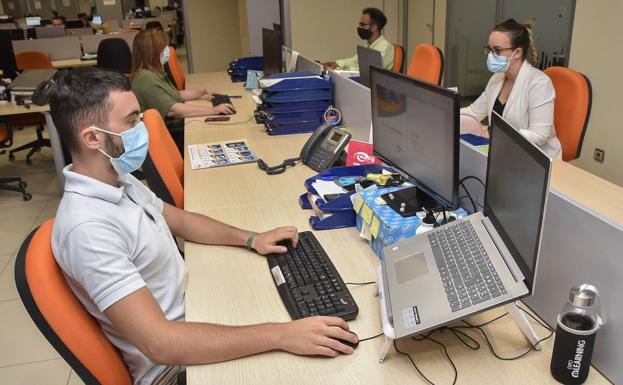
As a general rule, workplaces are free from the obligation to use a mask, except for public transport, health centers and establishments, and residences.
The Ministry of Health has published, together with the decree published in the BOE this Wednesday, a guide that companies must follow to impose or not impose the mask in the workplace (Protection_Workers_SARS-CoV-2). The general rule, according to this decree, is that interior spaces (except public transport, health centers and establishments, and residences) are free from this obligation. But in work environments, risk prevention services will have to determine the need for face masks, based on an assessment of the exposure risk of employees. “In this process, workers will be consulted and their proposals will be considered,” the guide states.
The document considers masks as one more protective element to protect employees, which should not be taken into account in isolation, but rather should be combined with a whole series of characteristics of the workplace: “Risk prevention services Labor authorities will advise the employer and the opinion of managers, middle managers and representatives of the workers must be obtained. The following elements will be taken into account in the risk assessment: adequate ventilation, occupancy level, maintenance of interpersonal distance of 1.5 meters, length of stay, activity, temperature and relative humidity conditions, use of common spaces (changing rooms, canteens, etc.), shared means of private transportation, existence of vulnerable people in the workplace.”
Beyond this evaluation, Health recommends that companies organize work that minimizes risks. “If possible, avoid the massive coincidence of people, both workers and clients or users, in the work centers during the time slots of expected greatest influx. This measure must also be considered during rest periods.
Promote teleworking for the development of those activities whose nature allows it. Consider the adoption of mixed work options for those activities that do not require continuous presence.” It also prescribes the use of a mask in shared vehicles, guaranteeing the entry of outside air.
Until the company makes this evaluation and issues its assessment, workers will be able to decide for themselves whether or not to wear the mask. If you do not do so, employees will not be required to cover their faces, as it is not one of the exceptions that the law determines to continue wearing masks.
However, the general opinion of the unions is that the use of the mask prevails, "based on the principle of precaution and caution, responsible use and common sense." The problem will arise, logically, in medium or small companies that do not have a prevention service and which are the majority in Spain, when carrying out the risk assessment by the employer who is not a technician in occupational risks.
 English
  Spanish